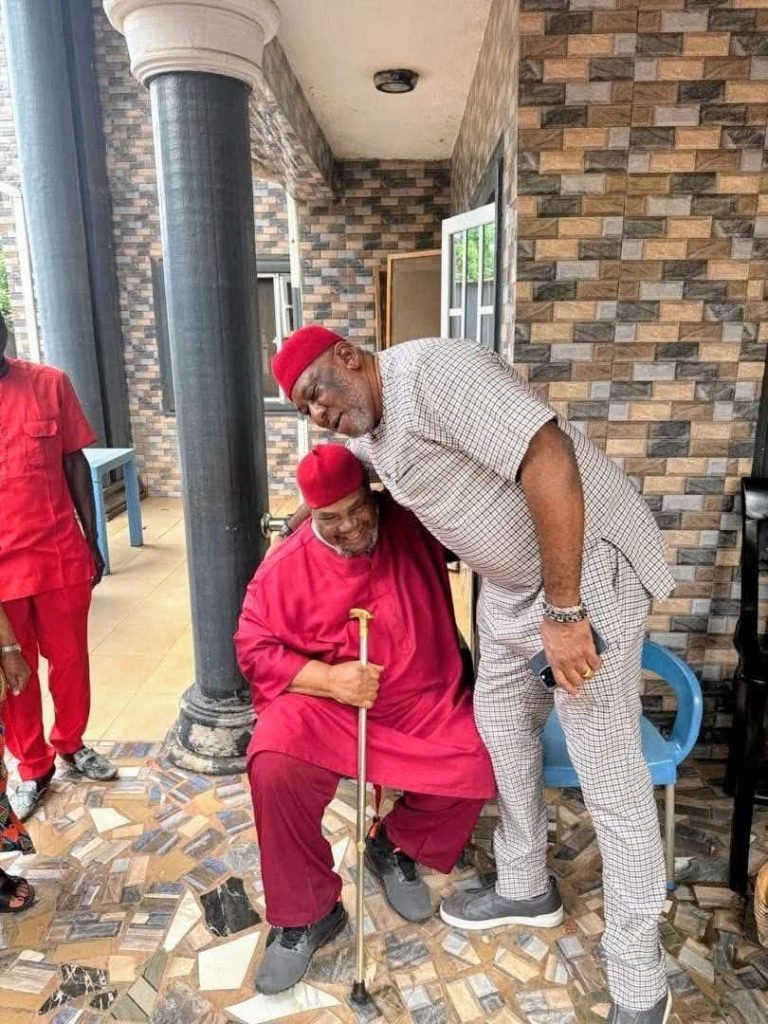



There is a reason President Bola Ahmed Tinubu stood respectfully before the Obong of Calabar—never seated, never casual. It is a reason far older than the presidency itself.
The throne of the Obong is not one that goes out to meet people; people come to it. This has been the order for centuries, a truth even colonial powers came to recognize. In the old days, the Obong never traveled to meet anyone, not even foreign administrators, because the Efik monarchy is structured on a core belief: the Natural Ruler sits, while others approach.

This principle was clear during the signing of the 1914 Amalgamation. Only six privileged Nigerians were selected to attend, and the Obongship was one of them. Yet, the Obong did not go in person; he sent Obong Richard Henshaw as his delegate, alongside figures like the Sultan of Sokoto and the Alaafin of Oyo. This was not disrespect. It was tradition. The throne could not leave the palace, but it could send a voice.
READ: Tributes Pour In for “Madam Cash,” Mother Killed in Mowe-Ibafo Road Accident

The same sacred protocol was upheld during the era of Prince Charles (now King Charles III). When he visited Nigeria, the British High Commission issued invitations summoning first-class kings to welcome him. The Obong of Calabar declined. Not out of pride, but because a king of his lineage is not summoned—by anyone. If a prince wished to honor the Efik throne, tradition required he come to the palace. The Efik people have maintained this principle for centuries, and even the British, who once wielded enormous influence, learned to respect it. The relationship between the Efik kingdom and Britain was not one of subservience; it was one of early diplomacy, intelligence, and cultural confidence.

Few people know that long before Western education spread across West Africa, the Efik were already engaging Britain directly. When the Obong wrote to the British asking for Western education—famously expressed in the plea, “Come teach us book”—Britain responded by sending the Hope Waddell missionaries to Calabar. That request was not a cry for help; it was a strategic vision. The Efik kingdom chose education as a tool for progress and invited it on their own terms. The Hope Waddell Training Institute did not fall from the sky; it was shipped to Calabar at the request of the Obong. That is the depth of the relationship: mutual respect, not colonial subjugation.
So when President Tinubu visited and stood with his hands behind his back, refusing to sit while addressing the Obong, he was following a cultural script older than Nigeria itself. He understood he was standing before a throne that predates colonization, predates the British Empire’s presence in West Africa, and predates even the idea of Nigeria. A throne that never moves to meet power, because power has always moved to meet it.
By: Otuekong Offiong Bassey
Discover more from TOKTOK9JA MEDIA
Subscribe to get the latest posts sent to your email.