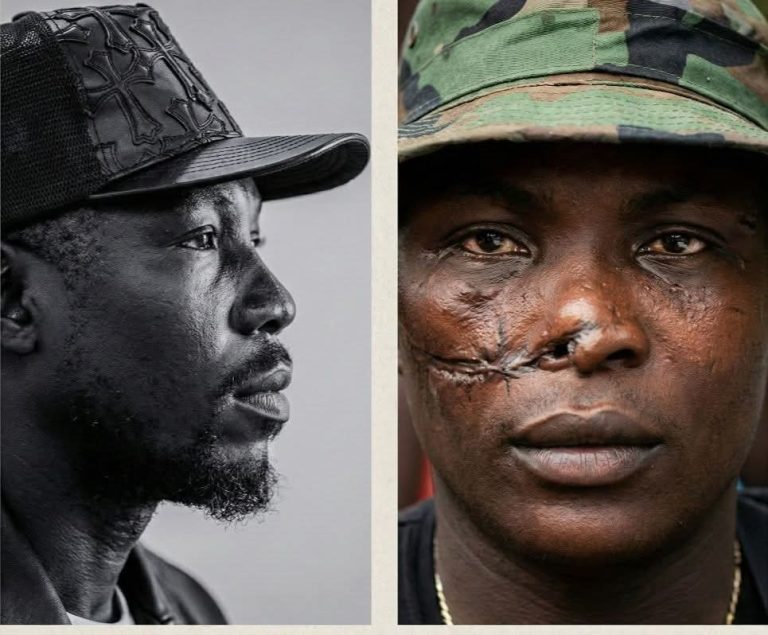




Why Did Farmer Samuel Get Death Sentence While ISWAP’s Commander Hussaini Got 20 Years?
A deep sense of public anger has taken hold across Nigeria following two court judgments that have been placed side-by-side, revealing a contrast in sentencing that many are calling unjust.
The cases involve Samuel Jackson, a farmer from Adamawa State, and Hussaini Ismaila, a known commander of the terrorist group ISWAP. The different outcomes of their trials have ignited a fierce debate about the balance of the nation’s judicial system.
READ: Security Alert: Two Trailers Carrying 550 People Intercepted at Adamawa Bridge

According to court proceedings, the incident involving Samuel Jackson began on his farm. Jackson was working when a herdsman entered his land with cattle, which were damaging his crops. Jackson asked the herdsman to leave. When the herdsman refused, Jackson attempted to chase the animals away himself.
This led to a physical confrontation. The herdsman stabbed Jackson twice. Jackson managed to run, but the herdsman chased him. A struggle followed, during which Jackson overpowered the herdsman, took his weapon, and stabbed him twice in the neck. The herdsman died from his injuries.
In court, Jackson pleaded not guilty, stating he had acted only to defend his own life. However, the judge found him guilty of murder, not manslaughter. The court ruled that once Jackson had disarmed his attacker, the immediate threat to his life was over, and his decision to then stab the man in the neck constituted murder. His sentence was death by hanging. An appeal later upheld the decision.
In a separate and vastly different case, Hussaini Ismaila, referred to as “The Dangerous Commander,” was tried for his role as an ISWAP leader. He was convicted for orchestrating attacks on multiple locations in Kano, including police stations, actions that led to the deaths of more than 100 people.

During his sentencing, his lawyer appealed to the court for leniency, arguing that Ismaila was now remorseful and did not wish to waste the court’s time. The judge sentenced the terrorist commander to 20 years in prison.
READ: The Throne That Power Must Approach: Why Tinubu Stood Before the Obong of Calabar
The public reaction to these two verdicts has been one of disbelief and fury. On social media and in public discussions, Nigerians are asking how a farmer defending himself on his own land receives the ultimate punishment, while a commander of a violent terrorist group, responsible for widespread death, receives a finite prison term.

Many are asking if Samuel Jackson would have received a fairer trial if he were a terrorist. Others are questioning whether his religious faith as a Christian played a role in the harsh judgment.
The case has also drawn international attention. It was recently mentioned during a hearing in the United States Congress, where a U.S. lawmaker called for Jackson’s pardon, pointing to what he described as a pattern of concern in Nigeria.
WATCH THE VIDEO:
Discover more from TOKTOK9JA MEDIA
Subscribe to get the latest posts sent to your email.