


Viral Video of Cardinal Holding Skull Sparks Debate as Theologian Defends Veneration of Saint’s Relics.
A viral video showing a Catholic cardinal holding a human skull has ignited fierce debate on social media, with many accusing the Church of idolatry. One commentator has stepped forward to offer a detailed biblical response.
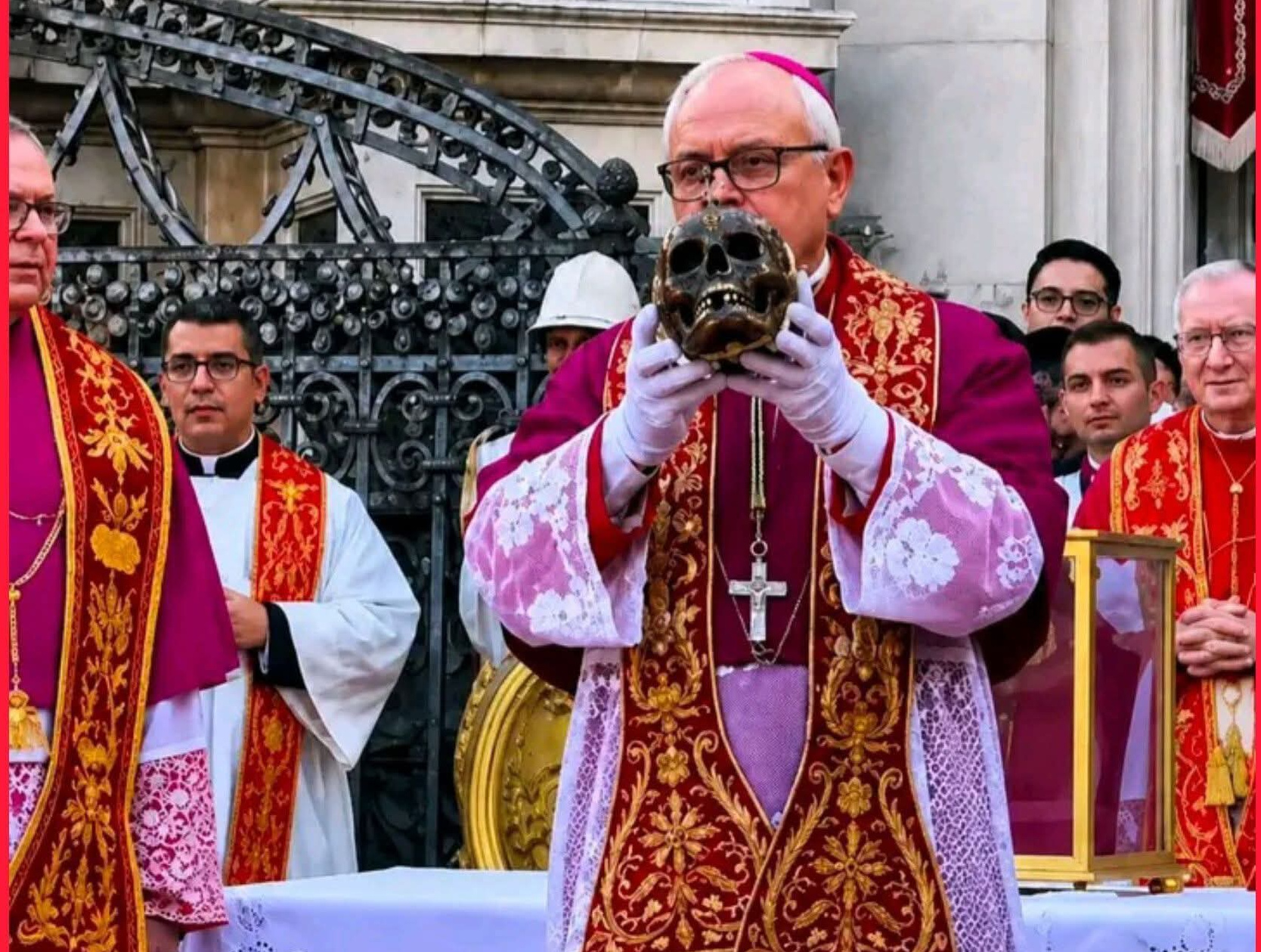
The clip, which shows Cardinal Pietro Parolin holding what is believed to be the skull of St. Agatha, a third-century Christian martyr, has been shared widely across platforms. Many commenters expressed shock, with some describing the act as “worship of the dead” and others questioning why Church leaders would display human remains in public.
But Emmanuel Atuanya, a Facebook user, has taken to the platform to offer what he describes as a biblical and theological clarification. In a lengthy post, he argued that the practice is not only defensible but deeply rooted in Scripture.
Relics: What They Are and What They Are Not
Atuanya begins by explaining the meaning of the term relic, which comes from the Latin reliquiae, meaning “remains” or “that which is left behind.” He stresses that relics are not objects of worship but reminders of the lives of holy men and women who lived out their faith in extraordinary ways.
“Catholics do not believe that bones possess magical powers,” he wrote. “We honor the remains of saints because their bodies were temples of the Holy Spirit.”
He quotes 1 Corinthians 6:19 to support this, pointing out that the Apostle Paul described the bodies of believers as dwelling places of the Spirit. If the body of a living believer is sacred, he argues, then the body of a saint who has died in grace is also worthy of honour.

The Crucial Distinction: Adoration Versus Veneration
Central to Atuanya’s argument is the distinction between latria, the worship due to God alone, and dulia, the reverence or honour given to the saints. He insists that Catholics do not worship St. Agatha or her remains. To do so would be idolatry, and the Church has always taught against it.
“The Catholic who worshipped St. Agatha or her skull as God would indeed commit idolatry,” he writes. “But that is neither what the Catholic Church teaches nor what this ceremony signifies.”
He argues that the viral video shows veneration, not worship. The difference, he says, is theological and biblical.
Scriptural Foundations for Venerating Relics
Atuanya draws heavily on the Old Testament to demonstrate that the honouring of material objects associated with holy people is not foreign to biblical faith.
He points to the account in 2 Kings 13:20–21, where a dead man is thrown into the tomb of Elisha and revives upon touching the prophet’s bones. “Elisha was dead, yet God chose to perform a miracle through the bones of His deceased prophet,” he observes. “Were the bones God? No. Was Elisha being worshipped? No. The power belonged entirely to God.”
He also references Elijah’s mantle, which divided the Jordan River after the prophet was taken to heaven. In 2 Kings 2:14, Elisha strikes the water with the same mantle and asks, “Where is the LORD, the God of Elijah?” The water parts once again. Atuanya notes that Elisha was not worshipping the garment; God chose to work through a physical object connected to His servant.
Joseph’s command that his bones be carried out of Egypt, recorded in Genesis 50:25, is another example. Moses faithfully honoured this request, and the bones were buried in the Promised Land. “The Bible therefore does not regard the remains of God’s holy servants as spiritually meaningless biological material,” Atuanya writes.
READ: 82-Year-Old Rose Shares How Sitting Outside Her Door Every Day Changed Lives
God and Material Objects in the Old Testament
The commentator also addresses the objection that Catholics use statues and images in worship. He notes that the same God who forbade idolatry also commanded the construction of sacred images, including the cherubim on the Ark of the Covenant and the bronze serpent that healed the Israelites.
“When people later began treating that serpent idolatrously, Hezekiah destroyed it,” he writes, referencing 2 Kings 18:4. “There lies the crucial distinction: sacred use of a material object is not idolatry. Giving divine worship to that object is.”
The New Testament Example
Atuanya also turns to the New Testament, pointing out that the early Church continued this pattern. In Acts 5:15, people brought their sick into the streets so that Peter’s shadow might fall on them. More strikingly, Acts 19:11–12 records that handkerchiefs and aprons that had touched Paul’s body were taken to the sick, and they were healed.
“Material objects that had physically touched an Apostle were taken to other people, and God worked miracles through them,” he writes. “Notice that Scripture says God performed the miracles. The objects possessed no independent magical power.”
The woman with the haemorrhage who touched the garment of Jesus and was healed is another example from Matthew 9:20–22. It was not the cloth that healed her, but Christ. Yet He chose to work through the physical.
The Incarnation and the Body
Atuanya argues that the Christian faith is inherently physical. At the centre of the faith is the declaration that “the Word became flesh,” recorded in John 1:14. Christ used touch in healing, clay to restore sight, water in baptism, and oil in anointing. The Apostles communicated grace through the laying on of hands.
“Christianity does not teach that matter is evil or spiritually useless,” he writes. “Christianity proclaims both the Incarnation and ultimately the resurrection of the body.”
The saints, he adds, are not dead but alive in Christ, as Jesus Himself declared in Mark 12:27: “He is not God of the dead, but of the living.” Hebrews 12:1 speaks of a “great cloud of witnesses” surrounding believers, and Revelation depicts the saints and martyrs in heaven, aware and interceding.
What the Early Church Believed
The practice of venerating relics, Atuanya notes, did not appear in the Middle Ages. The early Christians carefully preserved the remains of their martyrs. St. Augustine records miracles associated with the relics of St. Stephen in The City of God, and St. Jerome made the distinction that Christians do not worship martyrs as God but honour them because they belong to God.
The Catechism of the Catholic Church, he observes, recognises the veneration of relics as part of historic Christian piety, always subordinate to Christ and the sacred liturgy.
Final Thoughts
Atuanya concludes by urging critics to consider the biblical examples before levelling accusations. “Why did God raise a dead man through Elisha’s bones? Why did Elijah’s mantle divide the Jordan? Why were people healed in connection with Peter’s shadow? Why did Paul’s handkerchiefs and aprons become instruments of miraculous healing?” he asks.
“God may use material realities associated with His holy servants as instruments and signs of His grace without those objects becoming gods,” he writes. “Catholics worship God alone—Father, Son and Holy Spirit. We honour the saints because God’s grace has triumphed in them.”
He ends with Psalm 116:15: “Precious in the sight of the LORD is the death of his saints.”
“The relic points to the saint,” he writes. “The saint points to Christ. And all glory ultimately belongs to God. That is not idolatry.”
Discover more from TOKTOK9JA MEDIA
Subscribe to get the latest posts sent to your email.