


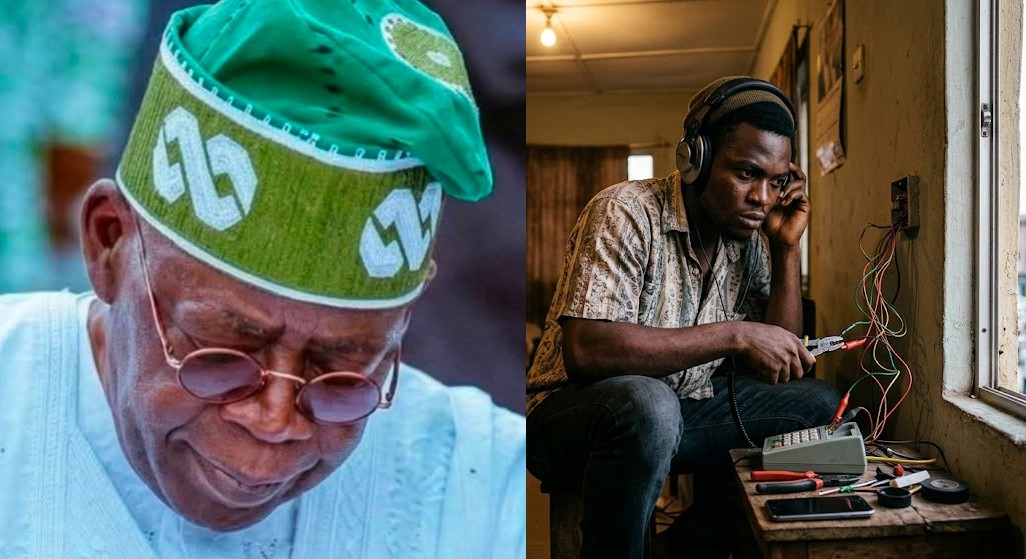
Why No One Can Leak Tinubu’s Calls or Voice Notes – A Look at Presidential Security Architecture.
A few days ago, an audio clip started making the rounds on social media. It carried a voice that sounded like President Bola Ahmed Tinubu, and the recording allegedly contained provocative comments about the 2027 election, unrest in the South-East, and heavy borrowing from the World Bank.
The clip was shared widely, and many people took it seriously. But soon enough, fact-checkers and tech analysts discovered something important. The audio was not real. It had been created using artificial intelligence.
That discovery did not stop some Nigerians from asking a different question. If the audio was fake, why someone cannot just leak a real conversation from the President? Why have no actual phone calls or voice notes from President Tinubu ever surfaced online?
An entrepreneur named Ugoji Maximillian has stepped forward with a detailed answer to that question. And according to him, anyone asking it simply does not understand how presidential security works anywhere in the world.
READ: The Push for Digital IDs and Digital Currency: What It Means for Your Money
President Does Not Use an Ordinary Phone Line
Mr Ugoji explained that a sitting president is not like an ordinary politician carrying an iPhone with a regular MTN or Glo line. The moment someone becomes the Commander-in-Chief, their entire way of communicating changes completely.
He pointed to the United States as an example. The American President travels with the White House Communications Agency, military encryption teams, satellite systems, mobile command centers, anti-jamming technology, and secure communication bunkers. Air Force One alone has more than eighty secure communication systems on board. The aircraft is built to work as a flying war room, even during a nuclear emergency.
That is why American presidents can order military operations from the sky. Their calls do not pass through normal telecom networks. They go through encrypted military systems.

What Protects the Nigerian President
Mr Ugoji then turned his attention to Nigeria. He asked whether anyone truly believes President Tinubu discusses sensitive state matters on an ordinary WhatsApp call like a local government chairman.
According to his post, the Nigerian President is protected by several layers of security when it comes to communication. These include:
- DSS electronic intelligence units
- Military Signals Corps
- Presidential Air Fleet secure systems
- National Security Agency cyber intelligence teams
- Anti-surveillance protocols
- Signal interception countermeasures
- Rotating secure devices
- Multiple encrypted communication layers
He added that even the President’s movements are kept secret until the last possible moment. The vehicles he rides in are not ordinary cars.
Mr Ugoji used a recent example. As President Tinubu is was in Lagos during the Sallah holiday, observant Nigerians noticed that he was being driven in his official vehicle. That vehicle did not come from a local garage. The Air Force flew it from Abuja to Lagos along with a few others.
Why go through all that trouble? Because of the security features built into those vehicles. And if that is the level of care given to cars, Mr Ugoji argued, imagine what goes into protecting the President’s phone calls.
Presidential Calls Are Not on Normal Networks
The entrepreneur further explained that most presidential calls worldwide are routed through heavily encrypted government-controlled systems, not commercial lines. This is why real leaks are extremely rare.
When leaks do happen globally, they usually come from one of a few sources: insiders with access, hacked aides, unofficial apps, or simple human error. No one ever records the President’s normal call or voice notes directly.
He pointed to a recent incident in America where officials improperly used apps like Signal and other unsecured devices. Intelligence experts immediately became worried because senior leaders are supposed to use hardened government systems, not everyday apps. That alone shows the level of security expected around heads of state.
The Scale of Presidential Protection
Mr Ugoji also noted that many people underestimate how much work goes into protecting a president. When President Tinubu travels, advance teams move ahead days earlier. Airspace is monitored. Communications are secured. Electronic sweeps are conducted. Convoy routes can change without warning. Multiple agencies coordinate everything at the same time.
Even back in the 1960s and 1970s, American presidential aircraft already used secure voice scrambling technology. Today’s systems are far more advanced. This is why serious countries spend enormous amounts of money on executive protection infrastructure.
A Final Word for Nigerians
Mr Ugoji ended his post with a message for the public. He said many Nigerians still think governance works like gossip blogs and TikTok live sessions. He urged people to open their eyes and understand that things do not work that way.
A president is not just a politician. He is a moving national command center. And the security around his communications is designed to make sure that no fake audio can be passed off as real, and no real conversation can ever find its way to the public through a leak.
The fake audio that sparked this discussion has since been taken down from many platforms. Security agencies have not announced any arrests related to its creation or distribution. However, the incident has served as a wake-up call for many Nigerians about two things: how convincing AI-generated content has become, and how much they did not know about the protection around their President’s daily communications.
As Mr Ugoji put it, believing that a sitting president’s private calls can just leak online is like believing the Commander-in-Chief runs errands using a motorcycle taxi. It simply does not happen…see more
Why No One Can Leak Tinubu’s Calls or Voice Notes – A Look at Presidential Security Architecture.
Discover more from TOKTOK9JA MEDIA
Subscribe to get the latest posts sent to your email.